Slate rock identification: texture, cleavage and photos
Slate is a very fine-grained metamorphic rock that commonly forms from mudstone or shale. Its closely spaced planar partings, called slaty cleavage, help identify it. A flat shape or gray color alone does not distinguish slate from shale or other rocks.
In this guide
How to recognize slate rock
Slate is a very fine-grained metamorphic rock with a strong tendency to separate along closely spaced, flat planes called slaty cleavage. It commonly forms when mudstone or shale undergoes low-grade metamorphism. A dark color or a thin, flat shape alone does not identify it.
For a loose specimen, inspect existing broad surfaces and the edges between them. Look for a consistent planar fabric through the rock. You do not need to split it to start the comparison.
 ROCK SCAN
Identify your rocks
Take a photo to explore a possible match.
iPhone and Android · In-app purchases
The features that matter
The British Geological Survey defines slate by its compact, fine-grained texture and pronounced splitting into thin plates. Mudstone is a common starting material, although other origins occur.
| Observation | Why it helps | Limitation |
|---|---|---|
| Very fine texture | Individual grains may be too small to distinguish by eye | Shale can also be very fine-grained |
| Repeated flat partings | Consistent slaty cleavage is a useful structural clue | A single flat surface could be a cut face |
| Similar material across adjacent plates | Supports a pervasive fabric rather than just alternating beds | Weathering can obscure surfaces |
| Dull to modest surface reflection | Helps compare a sample with silky phyllite | Wet surfaces and lighting change the appearance |
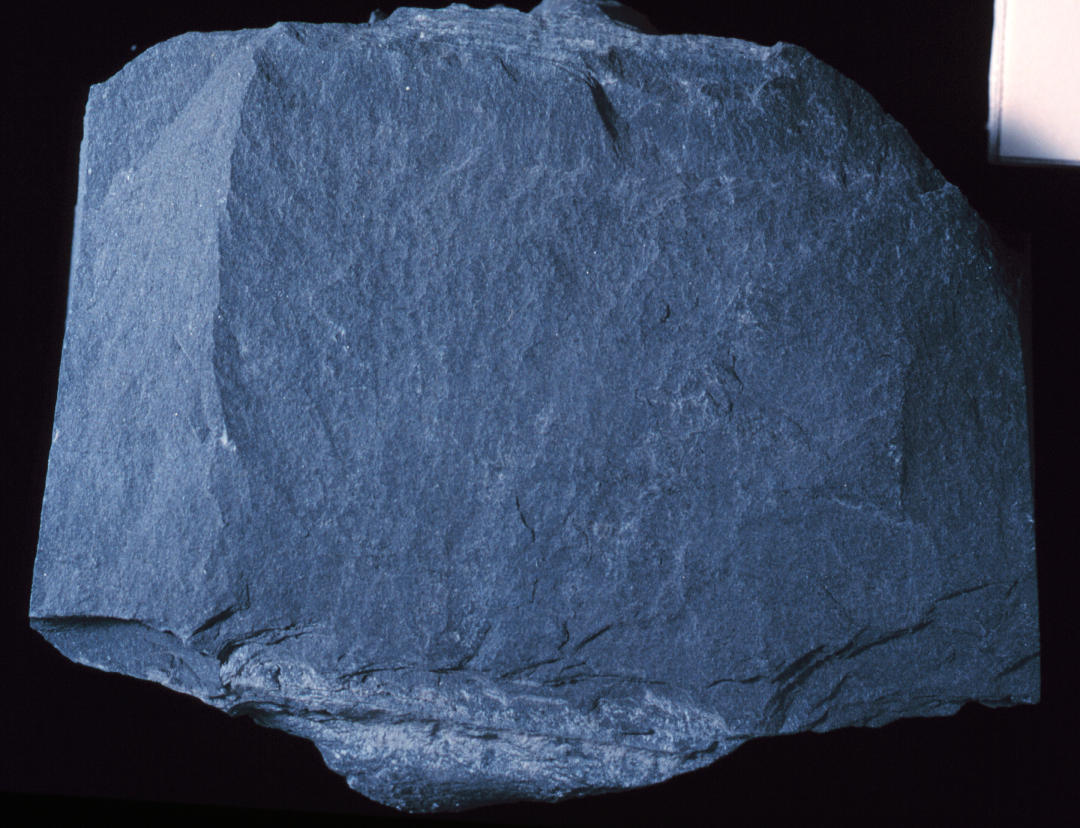
Our reference photograph shows gray Bangor slate from Pennsylvania. Its broad surfaces are useful to examine, but the photograph is one example, not a color standard. Compare structure before trying to match its shade.
Slate, shale and phyllite: a practical comparison
| Rock | Formation and visible clues | Useful next observation |
|---|---|---|
| Shale | Sedimentary mudrock that can split into thin layers | Look for sedimentary layering and read the shale guide |
| Slate | Metamorphosed fine-grained rock with slaty cleavage | Trace repeated planar partings across more than one exposed face |
| Phyllite | Fine-grained metamorphic rock with a more noticeable silky sheen; surfaces may be wavy | Rotate a dry face under light and compare its reflection |
MIT's introductory rock-identification lab describes slate and phyllite using these texture and surface differences. A weathered fragment may still fall between clear examples. Record “possible slate or phyllite” if the visible evidence does not separate them.
ROCK SCANIdentify your rocks
Take a photo to explore a possible match.
iPhone and Android · In-app purchases
Slaty cleavage is not the same as sedimentary bedding
Bedding records layers laid down as sediment. Slaty cleavage develops during metamorphism as a fabric related to deformation and mineral alignment. The two structures can have different orientations.
The Physical Geology chapter hosted by Maricopa shows how aligned minerals produce foliation and how low-grade slate differs from more visibly micaceous rocks. This distinction explains why “it splits into sheets” is only the start of identification.
On a sample with both color bands and planar partings, photograph their relationship. Do the partings run parallel to the bands, or cross them? Do not assume every stripe is a cleavage surface. If neither relationship is visible, say so rather than drawing imaginary layers onto the photo.
Three observations to make at home
- View it dry. Put the stone on a neutral background. Note whether the surface looks grainy, smooth, dull or silky before changing the light.
- Turn it edge-on. Photograph the narrow edge as well as the broad face. A face-only picture can hide the repeated partings you are trying to assess.
- Keep the context. Record where the specimen came from and whether it is a natural fragment, a roof tile or a landscaping product. Manufactured cuts can make many rocks look flat.
These observations preserve the specimen and make a later opinion easier to assess. Avoid breaking, sanding or drilling an unknown rock simply to create a better photograph.
For a contrasting metamorphic texture, see the marble rock guide: it focuses on granular specimens rather than sheet-like splitting.
Is slate a mineral?
Slate is a rock: its name describes a material and texture rather than a single chemical compound. Tiny mineral grains make up the rock. The rock versus mineral comparison explains this distinction with other examples.
If a dark specimen splits into thin sheets, compare slate and shale on a broken edge to see whether the splits follow the original layers.
If you want a starting suggestion from your photographs, download Rock Scan and compare the possible match with the structural clues above. A flat gray stone may still need examination in person. For uncertain or important samples, a local geology collection or mineral club can help compare actual specimens.
Sources
ROCK SCANIdentify your rocks
Take a photo to explore a possible match.
iPhone and Android · In-app purchases