How to Identify Banded Iron Formation in a Hand Specimen
In a typical banded iron formation (BIF), iron-rich layers alternate with silica-rich layers. Trace several bands across the rock and around an edge. Red jasper makes some examples distinctive, but a specimen made of gray quartz and dark hematite can show the same structure.
In this guide
Trace the bands around an edge
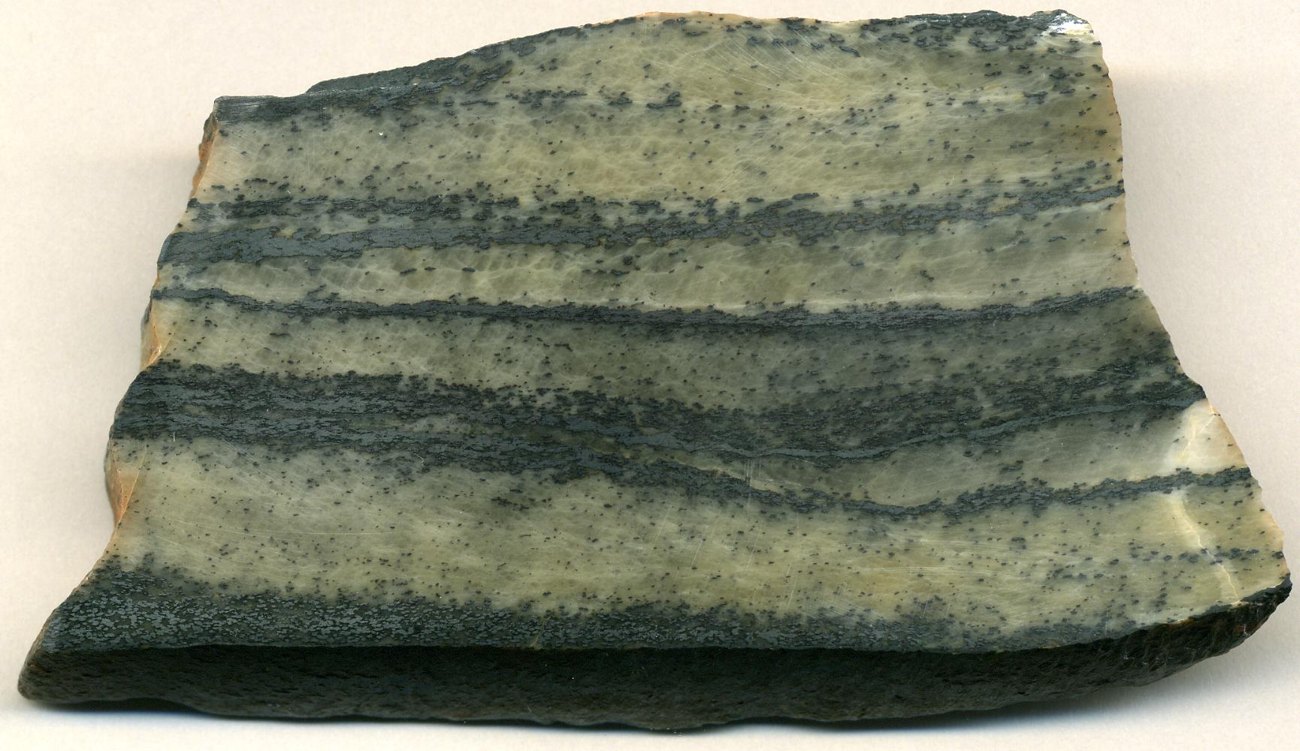
Start with a face that crosses the layers. In the Australian specimen above, the pale bands are quartz and the darker bands are hematite. The specimen is 8.4 cm across. Follow one dark band from left to right, then inspect the pale layers on either side. Photograph your own specimen from a second angle to see whether the layers continue into its interior. A face viewed along a single layer may show little banding at all.
Iron formations began as iron-rich sediments, many in Precambrian seas. Later folding or metamorphism can bend and recrystallize their layers. A curved stack that stays in sequence can preserve the pattern just as well as a straight one. The bands alone cannot tell you the age of a loose rock.
 ROCK SCAN
Identify your rocks
Take a photo to explore a possible match.
iPhone and Android · In-app purchases
Compare a red-banded specimen
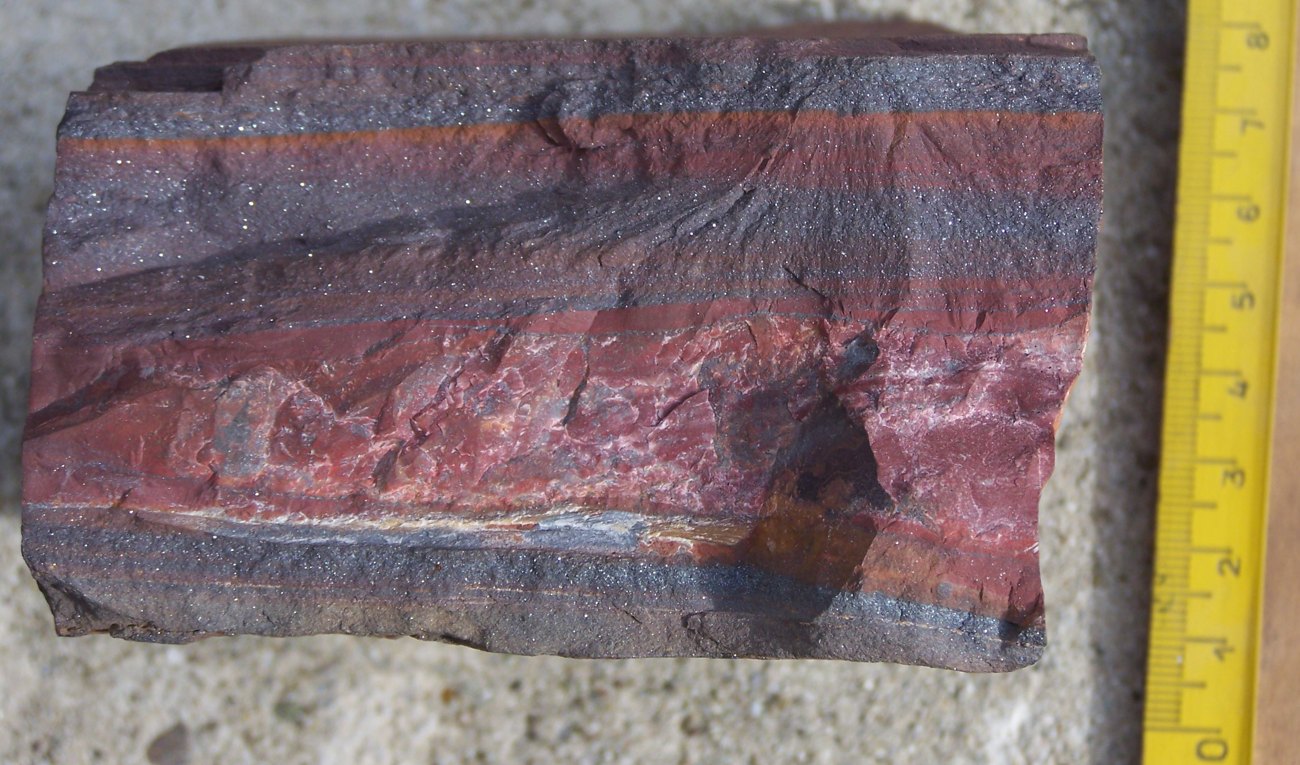

Use the centimeter scale to judge the widths of the bands. The red layers in this specimen are much easier to pick out than the pale layers in the Australian example. Jasper is iron-colored, opaque silica and can form red bands in BIF. A red stripe on its own says little about the composition of the neighboring stripe.
Separate BIF from other striped rocks
| Candidate | Detail to examine |
|---|---|
| Banded iron formation | Repeated iron-rich layers alternate with silica-rich layers across the exposed face |
| Banded jasper or chert | Color changes within fine silica may make stripes without distinct iron-rich layers |
| Gneiss | Look for visible interlocking mineral grains, with pale quartz or feldspar alternating with darker mineral-rich bands |
| Surface staining | Rust-colored patches may follow cracks or coat only the outside of the rock |
Examine an intact dry face in diffuse light. A small magnet may respond where magnetite is abundant. Hematite-rich BIF may give little response, and other magnetite-bearing rocks also attract a magnet. Record where the pull is strongest and whether it changes across the banding. Use the magnetic rock identification guide for other explanations of a positive result.
Make a field record
Place a ruler across the layers, perpendicular to their edges. Record the widths of one dark band and the two pale or red bands beside it. Note any fold, interrupted layer or weathered rind. If the rock came from an outcrop, record the location before comparing it with a regional geologic map. For an undocumented pebble, “banded rock with possible iron-rich layers” is a useful field label until its composition is checked.
Print the banded iron formation specimen plate (PDF) for the two photographs and an observation record.
Sources
ROCK SCANIdentify your rocks
Take a photo to explore a possible match.
iPhone and Android · In-app purchases