Smoky quartz identification: color, crystals and photos
Smoky quartz is a gray to brown variety of quartz with Mohs hardness 7 and no cleavage. Natural crystal shape and existing fracture surfaces help narrow an identification. Color alone cannot confirm the mineral or establish its treatment history.
In this guide
What is smoky quartz?
Smoky quartz is a gray to brown variety of quartz, sometimes dark enough to appear almost black. It shares quartz's Mohs hardness of 7 and lack of cleavage. The smoky color is a useful starting clue, but a brown or gray stone still needs other evidence before you label it quartz.
The Zuhl Museum at New Mexico State University records smoky quartz as a brown-gray form of silicon dioxide. Use a confirmed specimen as a comparison, while allowing for differences in lighting, surface condition and shape.
 ROCK SCAN
Identify your rocks
Take a photo to explore a possible match.
iPhone and Android · In-app purchases
Check these features together
| Feature | What smoky quartz can show | Why this is not proof by itself |
|---|---|---|
| Color | Gray, brown or very dark smoky tones | Other minerals and glass can have similar colors |
| Surface reflection | A glassy look on exposed faces or breaks | Polish can make different materials look alike |
| Crystal outline | A natural quartz crystal may have a six-sided prism and pointed termination | Cut points imitate a crystal outline; broken specimens may have no point |
| Existing breaks | Irregular or curved, shell-like fracture rather than repeated cleavage planes | Glass can also have curved fracture |
| Hardness | Mohs 7 | A photograph does not measure scratch resistance |
The Minerals Education Coalition's quartz reference lists its composition, hardness and fracture. Treat those as properties to investigate, not as measurements you have already made on your own stone.
Start with the surface you actually have
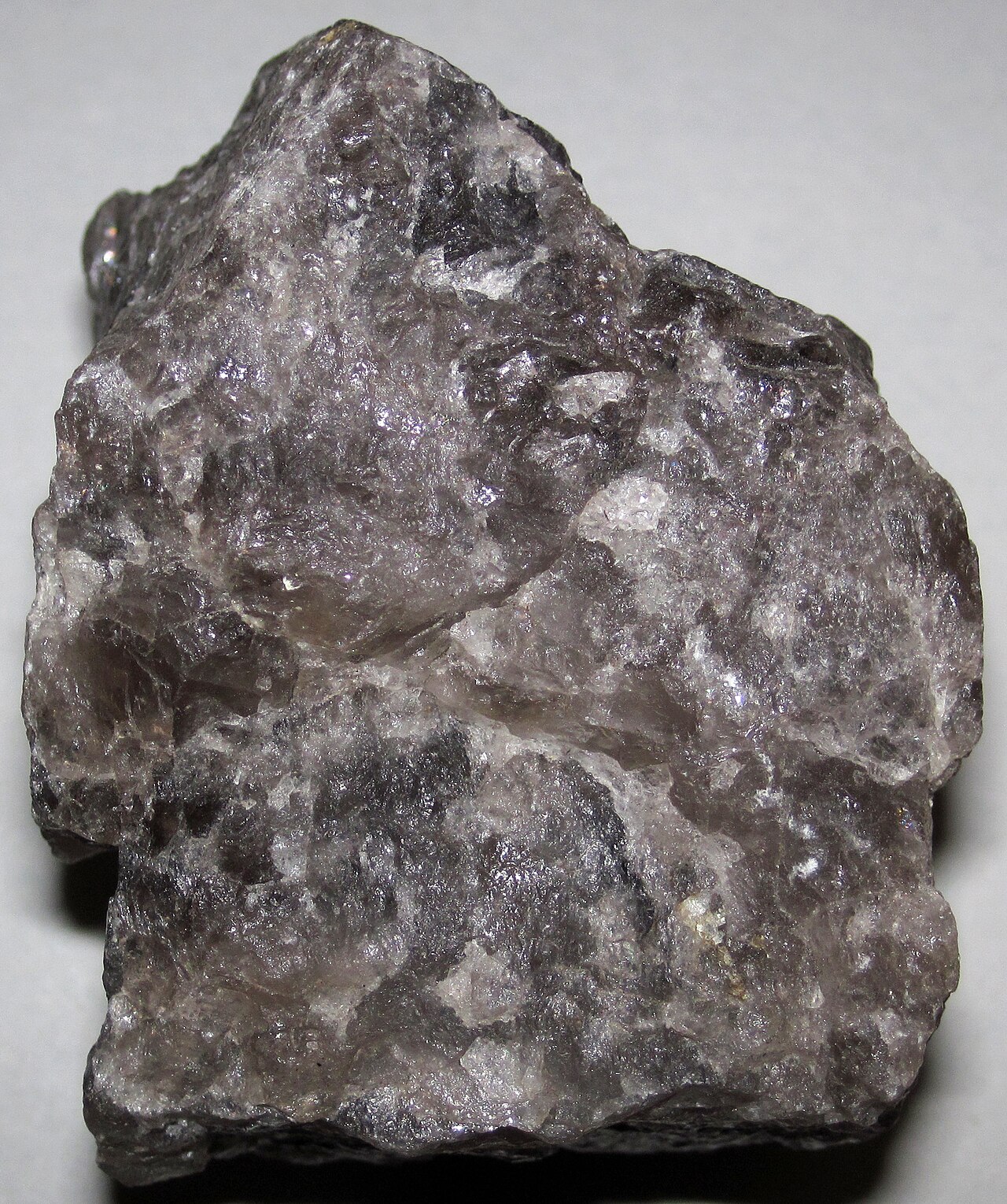
A rough fragment, a natural crystal and a polished pebble offer different clues. Our smoky quartz photograph shows an irregular rough specimen with reflective broken surfaces. It does not show an intact six-sided crystal point, so do not try to find a point that is not there.
For a natural-looking crystal, examine the sides and termination from several angles. For a rounded pebble, describe visible color and any surviving rough patch. For a cut decorative point, record that the shape was manufactured; its outline cannot establish the original crystal form. For purple specimens, our amethyst vs. fluorite comparison shows how natural crystal faces can help tell purple quartz from fluorite.
Keep a short observation note. For example: “Brown-gray, translucent at a thin edge, irregular shiny breaks; no repeated flat cleavage visible.” Then list the unresolved questions. That leaves room for a different identification when better evidence appears.
ROCK SCANIdentify your rocks
Take a photo to explore a possible match.
iPhone and Android · In-app purchases
How it differs from calcite and dark glass
Calcite can also look glassy, but its three cleavage directions may produce repeated slanted, flat breaks. Quartz lacks cleavage and can show curved fracture. The Open University's specimen examples show that distinction. Our quartz versus calcite comparison provides a closer side-by-side guide.
Dark glass presents a different problem: color and a shell-like break may resemble quartz. Do not decide that a polished brown stone is genuine smoky quartz simply because it shines or has no obvious cleavage. A gemologist can examine properties that a photograph cannot capture.
Avoid scratching a finished stone or breaking a crystal to settle the question. A damaging test is especially unhelpful when you have not established which surface or material you are testing.
Does the color show whether it was treated?
Natural radiation can create smoky coloration in suitable quartz. Irradiation can also produce that color artificially: the ORAU Museum of Radiation and Radioactivity documents a treated quartz example beside an untreated one.
Color alone therefore cannot establish a specimen's treatment history. Keep the seller's disclosure and locality information, and seek professional assessment if treatment matters to a purchase. A darker stone is not automatically more natural, more valuable or easier to identify.
Take photos that retain the useful clues
Use indirect daylight and a plain background. Take an overall photo, a view of the best existing edge, and another with a ruler for scale. Photograph thin and thick parts under the same light so that you do not confuse a dark shadow with the stone's body color. Avoid filters that increase brown tones or contrast.
You can download Rock Scan to explore a possible match and choose which features to compare next. Use the suggestion as a starting point. If your sample is banded rather than uniformly smoky, the agate identification guide may help you describe that pattern before deciding on a name.
Sources
ROCK SCANIdentify your rocks
Take a photo to explore a possible match.
iPhone and Android · In-app purchases