Calcite mineral: identification, cleavage and photos
Calcite is calcium carbonate with Mohs hardness 3 and three cleavage directions. Repeated slanted, flat breaks help distinguish it from quartz, but color alone is unreliable. Some clear specimens show double refraction.
In this guide
What is calcite?
Calcite is calcium carbonate, CaCO₃: a mineral found in many limestones, mineral veins and cave deposits. It has Mohs hardness 3 and three directions of cleavage. Those properties help identify it more reliably than its color, which varies considerably.
A white pebble is not automatically calcite. Neither is every pointed crystal quartz. Start by recording what the specimen actually shows, then compare the evidence below. If you are naming the whole rock rather than one crystal within it, first read rock versus mineral.
 ROCK SCAN
Identify your rocks
Take a photo to explore a possible match.
iPhone and Android · In-app purchases
Calcite identification at a glance
| Feature | What to look for | What it cannot establish alone |
|---|---|---|
| Color | Often white or colorless; colored varieties occur | A specific color does not identify calcite |
| Luster | Often glassy on a clean surface | Quartz and other minerals may also look glassy |
| Hardness | Mohs 3 on a suitable test specimen | Hardness cannot be measured from a photograph |
| Cleavage | Repeated flat breaks in three directions, forming slanted blocks | One flat face may be a growth face or a cut surface |
| Transparency | Some pieces transmit light; clear pieces may show a doubled line | A cloudy sample may hide this effect |
The Kansas Geological Survey's calcite reference documents its composition, hardness and variable colors. Use the table as a set of observations to combine, not a checklist where one match proves the name.
Read existing breaks without breaking your crystal
Turn the specimen slowly under a lamp. Compare several existing edges. Do flat surfaces repeat with the same orientation? Do the corners make a slanted box rather than a square cube?
Calcite can break into rhombohedral fragments. A rhombohedron resembles a box pushed sideways: its faces meet at oblique angles. The Open University's cleavage examples distinguish these internal breakage planes from crystal faces formed during growth.
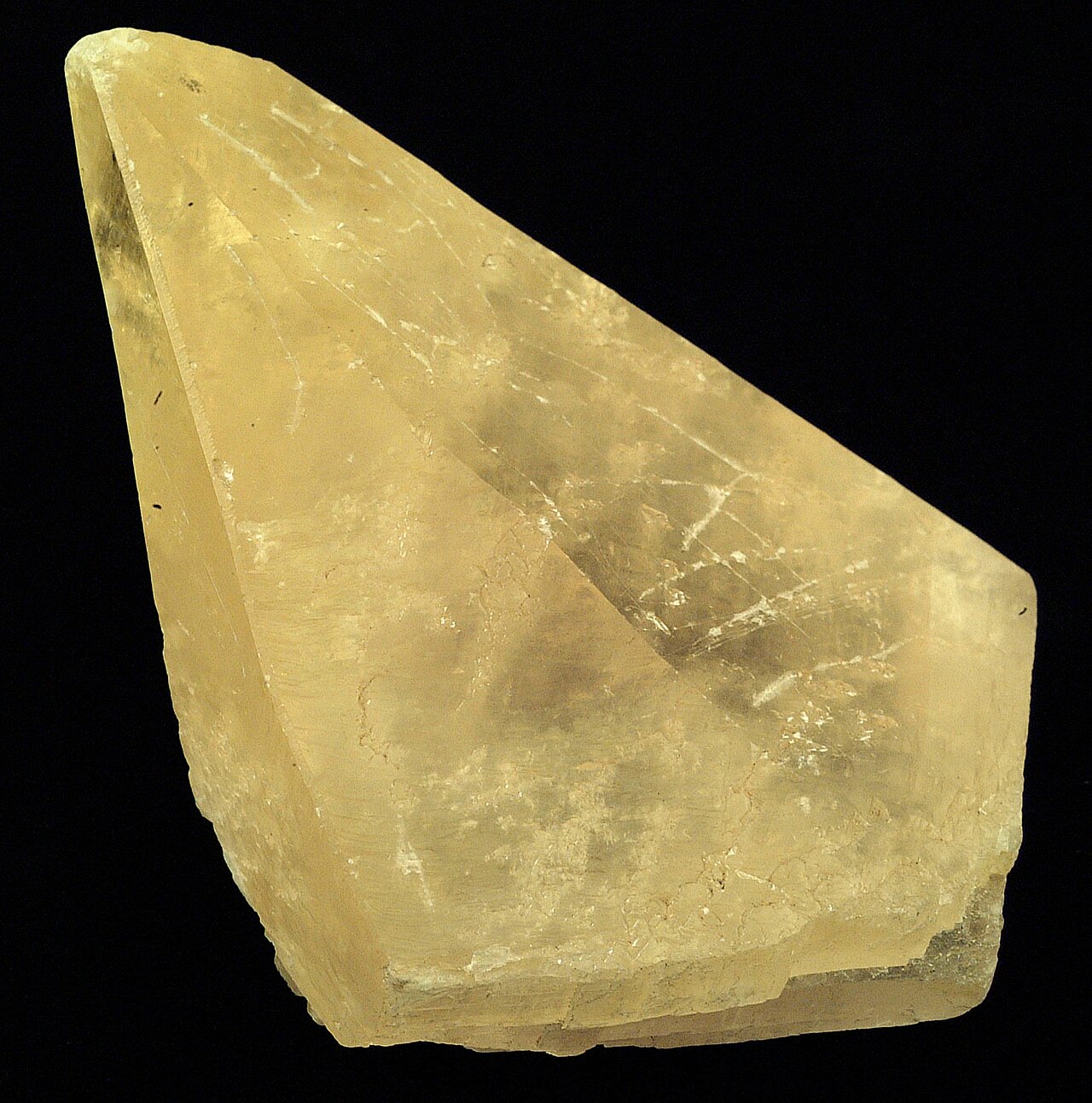
An intact crystal does not need to look like a rhombohedron. Calcite has many growth forms, including tapered “dogtooth” crystals. The Natural History Museum of Utah illustrates several of them. Our specimen photograph shows a tapered crystal, not a demonstration of every cleavage direction. Keep a good specimen intact; use its existing surfaces and provenance first.
ROCK SCANIdentify your rocks
Take a photo to explore a possible match.
iPhone and Android · In-app purchases
Is it calcite, quartz, or a rock containing calcite?
These are different questions. An individual crystal may be calcite, while the surrounding material needs a rock name. Limestone can contain calcite crystals too small to recognize individually; the Kansas reference also describes calcite acting as cement in sandstone.
For an isolated clear or white crystal, compare quartz and calcite. Quartz has Mohs hardness 7 and lacks calcite's cleavage. A photograph of a polished stone may conceal both distinctions, so an uncertain label is reasonable.
A practical observation might read: “White, glassy mineral in a darker host rock; three sets of flat breaks visible.” That is more useful than “looks like the calcite photo.” Keep the location or seller's label alongside your observations without treating either as proof.
If a brown-gray specimen remains a quartz candidate, use the smoky quartz guide to compare existing breaks, natural crystal forms and the limits of color-based identification.
What about the doubled-line test and vinegar?
Some transparent calcite produces a visible double image of a line beneath it. If you already have a loose, clear specimen with suitable surfaces, look through it at a printed line while rotating it. Failure to see doubling in a cloudy or awkwardly shaped piece does not exclude calcite. The Utah museum explains this optical effect and calcite's reaction with weak acids.
Acid reactions alter the specimen. Skip vinegar on jewelry, polished objects, valuable crystals and unknown mixed specimens. Do not treat “no obvious fizz” as a firm identification. An experienced mineralogist can select an appropriate test when observation is insufficient.
If you are examining a whole granular rock rather than a single crystal, our marble rock identification guide compares recrystallized carbonate rock with limestone and quartzite.
Photograph the evidence and keep the uncertainty
Take one overall photo, a close view of the best existing edges, and a separate image with a ruler for scale. Use indirect light and keep the original files. Include any host rock rather than cropping it away.
You can download Rock Scan to explore a possible photo match, then compare that suggestion with the properties above. A photo match cannot measure hardness or confirm an acid reaction. For an important specimen, bring the object and its history to a mineral club or qualified specialist.
Sources
ROCK SCANIdentify your rocks
Take a photo to explore a possible match.
iPhone and Android · In-app purchases