Amethyst vs fluorite: identify a purple crystal
Amethyst is purple quartz with Mohs hardness 7; fluorite has hardness 4. Natural amethyst often shows pointed quartz crystals, while fluorite can form cubes or octahedra. A cut point or a polished purple pebble may hide those useful differences.
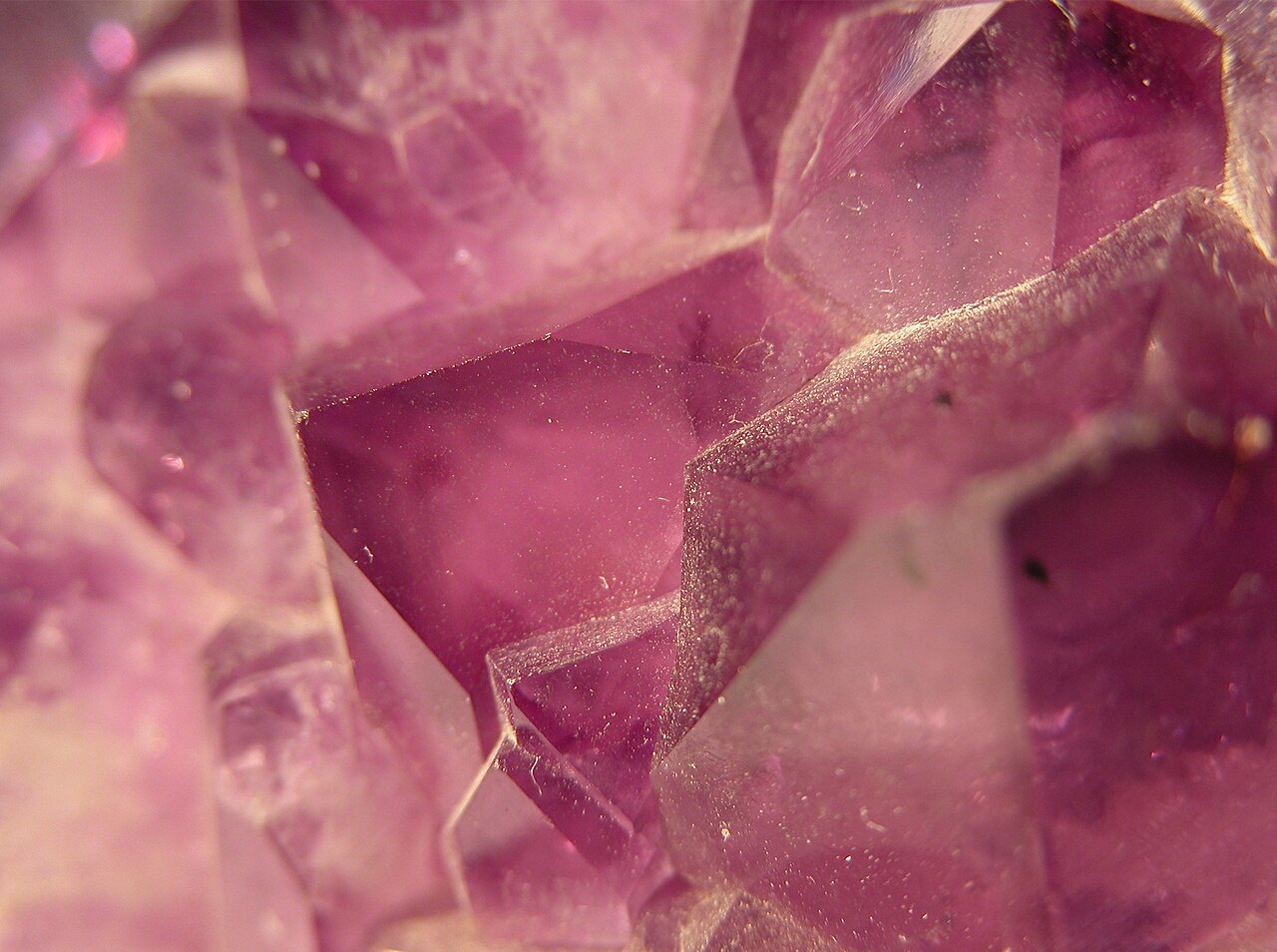
In this guide
- Start with the shape of the purple crystal
- Amethyst vs fluorite at a glance
- Compare faces and corners in natural specimens
- Compare your find with a real fluorite specimen
- Tumbled fluorite or amethyst: what can you check?
- Hardness helps, but scratching is not the first step
- Handle an unidentified purple stone gently
- A useful photo set for purple-crystal identification
Start with the shape of the purple crystal
Put the specimen under soft daylight and look at the sides as well as the point. On an intact natural crystal, shape gives you more to compare than the precise shade of purple. The Oxford University Museum of Natural History lists both amethyst and fluorite among purple minerals, alongside other candidates. Purple is a starting description, not a complete identification.
First establish whether the surface is natural, cut, or polished. A crystal cluster with points growing from a shared base is a different kind of evidence from a polished tower. A maker can cut several materials into the same decorative shape. Ask about the finish if you bought the object and cannot tell from its surface.
Amethyst vs fluorite at a glance
| Property | Amethyst | Fluorite |
|---|---|---|
| Material | Purple quartz | Calcium fluoride |
| Mohs hardness | 7 | 4 |
| Useful natural shapes | Quartz prisms with pointed terminations | Cubes and octahedra |
| Color alone | Purple does not establish identity | Purple does not establish identity |
| Cut or tumbled pieces | Natural shape may be absent | Natural shape may be absent |
| Best first photo | Point and adjoining side faces | Several adjoining faces and corners |
GIA gives amethyst a hardness of 7. The Minerals Education Coalition gives fluorite a hardness of 4 and describes cubic and octahedral crystals. Fluorite can also occur without a neat visible crystal shape, so the lack of a cube does not rule it out.
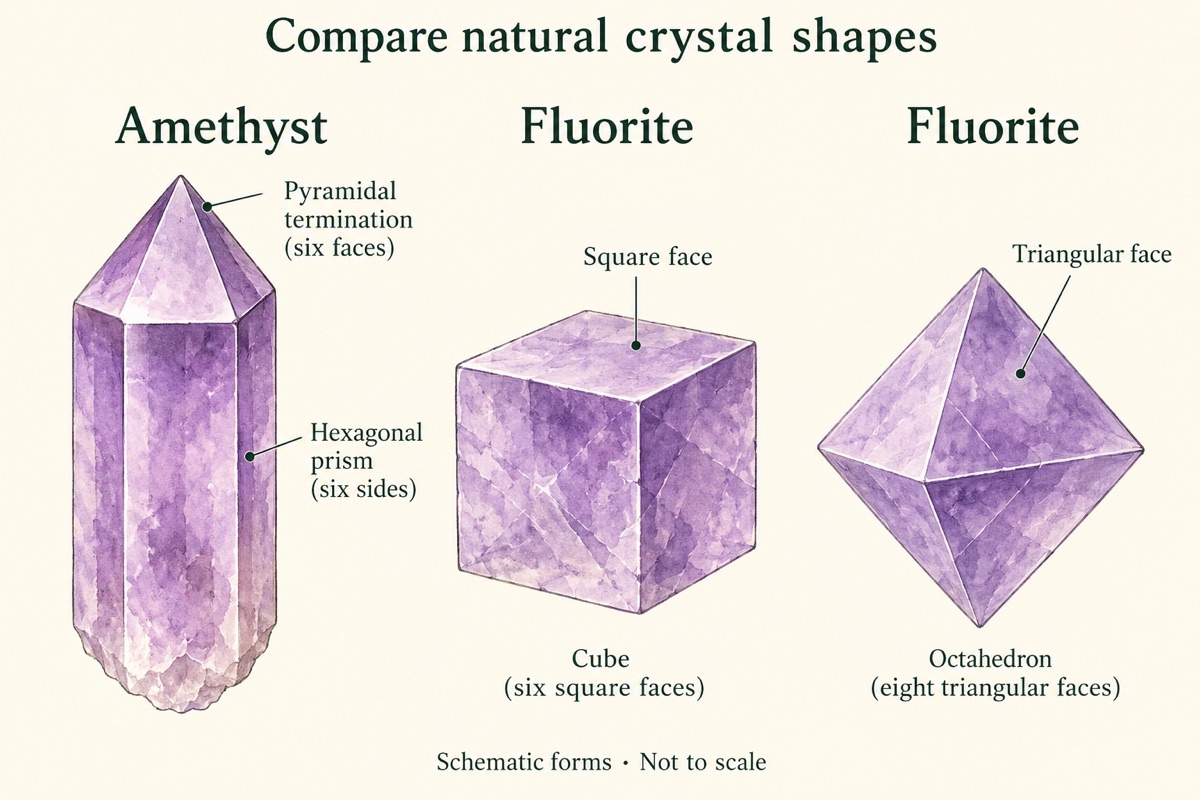
Compare faces and corners in natural specimens
A cube has six square faces. An octahedron has eight triangular faces, like two four-sided pyramids joined at their bases. Turn your specimen rather than judging a single silhouette: the side view may reveal an arrangement that a top-down photograph hides.
On a possible amethyst point, look along the length of the crystal. Try to distinguish the long side faces from the faces that meet at its end. The American Museum of Natural History’s mineral explainer uses crystal shape as an observable property and identifies amethyst as purple quartz.
Crowded clusters rarely look as tidy as a diagram. Neighboring crystals can hide a side, and an old break can remove the tip. Record “two square-looking adjoining faces” or “long prism with an incomplete point” rather than forcing the specimen into a perfect outline.
Compare your find with a real fluorite specimen
The photograph below is a fluorite reference. Use it to inspect relationships between visible faces, rather than expecting your stone to match its exact color or size. A specimen’s source label identifies the reference; resemblance alone does not identify yours.
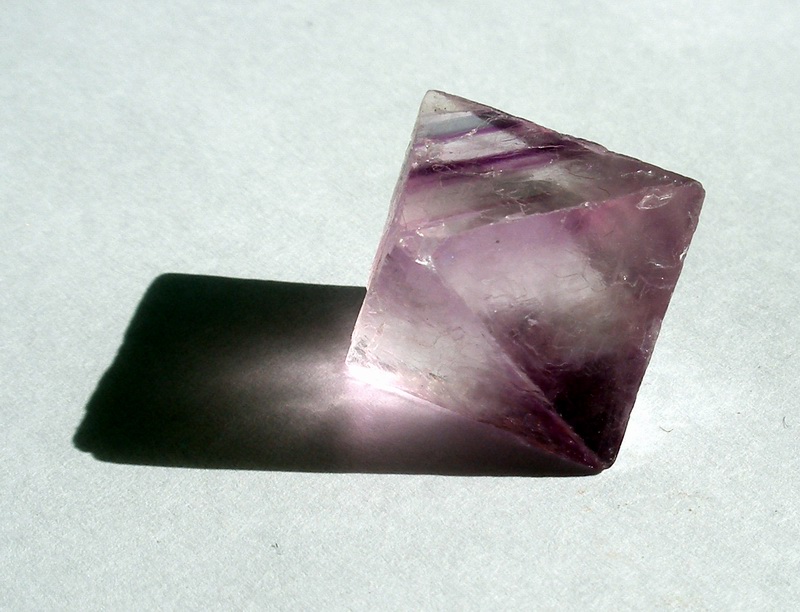

Put your own photo beside the reference and name one feature you can compare. If you cannot see the edge between two faces, take another view. If your stone has no preserved crystal faces, move to the polished-stone section instead of inventing a shape from reflections.
Color filters make this harder. A phone may brighten the purple or shift it toward blue under indoor lighting. Keep one unedited daylight photo and describe any color changes you see when you move the specimen.
Tumbled fluorite or amethyst: what can you check?
A polished purple pebble has lost much of the evidence that makes natural crystal shapes useful. Do not count the flat-looking reflections on a rounded surface as crystal faces. They may come from the window or lamp above it.
Photograph all sides and any visible internal pattern. Record whether the color looks uniform, patchy, or divided into zones. Those observations can guide a comparison, but a purple band alone does not confirm fluorite, and a deep purple shade does not confirm amethyst.
For a cut tower, ask whether the point follows a natural crystal or was shaped during manufacture. If the seller cannot say, record the object as cut or polished with an unknown original form. This keeps the attractive finish separate from the mineral question.
Hardness helps, but scratching is not the first step
The difference between 7 and 4 is useful in a controlled mineral examination. Mohs hardness describes resistance to scratching, not a stone’s resistance to every kind of damage. GIA also explains that the scale’s steps are uneven: seven is not a simple multiple of four.
Avoid testing a finished pendant, bracelet bead, or collectible point with a knife or another stone. Even a small test mark can damage the finish. If you have an expendable teaching sample, a mineral club can demonstrate reference-hardness testing and show how a scratch differs from a removable streak.
For a valued object, ask an examiner to choose an appropriate method. A jeweler or gemologist can also tell you whether the mounting limits access to useful surfaces. You do not need a home scratch-test result before seeking help.
Handle an unidentified purple stone gently
Until you know the material, keep pieces separate so they do not rub against one another. Use a padded surface while you photograph them. Do not drop a specimen to compare its sound or break it to inspect the inside.
For confirmed amethyst, GIA notes that abrupt temperature changes can cause fractures and prolonged intense light can fade some color. Those cautions are another reason to avoid heat-based identification tricks. They do not turn fading, or the absence of fading, into a test for an unknown stone.
If you want to compare another quartz lookalike, our quartz vs calcite guide explains how to separate visible surface clues from properties that require an in-hand examination.
A useful photo set for purple-crystal identification
Take a whole-specimen photo, a side view, and a close-up of the clearest natural face or existing edge. Add a ruler in one separate image. For a cluster, include its base so a reviewer can understand which points belong to the same object.
Note whether the stone was found, bought, or inherited. Keep a seller’s label with the photos, but distinguish the label from anything independently tested. Our observation sheet helps keep that record together.
Is fluorite the same as amethyst?
No. They have different compositions and hardness. Their shared purple color explains the confusion.
Does a pointed purple tower prove amethyst?
No. A manufactured point does not preserve the same evidence as a natural crystal. Check how the object was cut and what testing supports its label.
Can a photo app settle the identification?
Use its suggestion as a candidate. Compare the proposed mineral with your specimen’s visible form and known history. If the identification affects a purchase or repair, get an in-person examination.
Sources
 ROCK SCAN
Identify your rocks
Take a photo to find a match.

iOS 18+ · In-app purchases