Vesicular basalt: How to recognize lava rock with holes
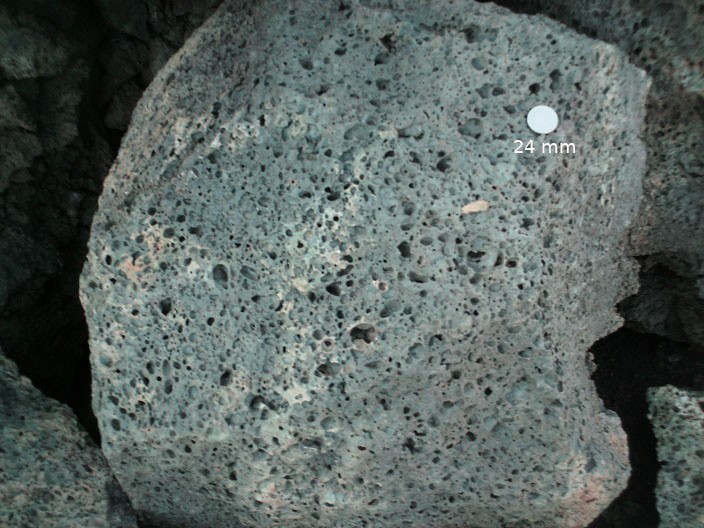
Vesicular basalt is basalt containing cavities left by gas bubbles in cooling lava. A typical specimen has a dark, fine-grained body with visible holes. The word **vesicular** describes the holes; **basalt** identifies the rock.
In this guide
If you have found a dark stone full of small cavities, vesicular basalt is a possibility. Start with the surrounding rock and the texture between the holes. A photograph of holes alone is rarely enough to settle the identification.
What created the holes?
Gas bubbles can grow in molten lava as pressure decreases. When the lava hardens around them, the cavities remain. The USGS explains these cavities as vesicles.
Their size and concentration can vary across a lava flow. The USGS describes Columbia River basalt flow tops where vesicles become more abundant toward the upper surface. A less bubbly piece and a strongly vesicular piece can therefore come from different parts of the same flow.

 ROCK SCAN
Identify your rocks
Take a photo to explore a possible match.
iPhone and Android · In-app purchases
Four observations to make first
- Look between the holes. Is the body fine grained, or is it visibly made of separate pebbles or coarse crystals?
- Inspect an existing exposed surface. Record the color beneath the weathered outer coating without breaking the specimen.
- Compare the cavities. Note their sizes, shapes and distribution. Photograph both a close view and the entire stone.
- Record the setting. A piece attached to a lava outcrop carries more geological context than a loose stone in landscaping or construction fill.
Place a ruler beside the specimen. A small hole can look much larger in an unscaled phone photograph. Take one picture in diffuse daylight and another with light from the side to show the relief.
Vesicular basalt vs. scoria
The terminology overlaps. Scoria commonly describes very bubbly volcanic material; vesicular basalt often has more solid rock between the cavities. Rutgers describes vesicular basalt as a largely solid basalt body textured with small vesicles.
Treat that distinction as a description of texture rather than a precise percentage you can estimate from a photo. Color and apparent weight help build the description but do not provide an absolute boundary.
Our pumice vs. scoria guide explains another common comparison.
ROCK SCANIdentify your rocks
Take a photo to explore a possible match.
iPhone and Android · In-app purchases
Vesicular basalt vs. pumice
Pumice also contains abundant cavities, so “it has holes” does not distinguish the two. Look at the texture of the material between them, how much solid material is present, and the overall geological setting.
Avoid using a float test as your only identification method. Whether an individual porous rock floats can depend on its pore structure and how much water it has absorbed. Keep the specimen’s full set of observations together.
What if the holes contain white or colored material?
Former gas cavities can later become filled with minerals. Geologists call this an amygdaloidal texture. A filled cavity and an empty vesicle record different stages in the history of the same volcanic rock.
Do not name the filling from color alone. Photograph the boundary between the filling and host rock. A hand lens may show crystal shapes or banding that a distant photograph misses. Those details are more useful than assuming every white patch is quartz.
When the answer should stay tentative
A dark porous piece found in industrial fill may need comparison with manufactured material. A heavily weathered specimen may hide the original groundmass. In either case, write down the uncertainty and retain the location information.
Use Stone’s identification tools as a starting point, then compare the suggested match with these observations and a geological source. For a scientifically important specimen, seek a qualified identification.
Sources
ROCK SCANIdentify your rocks
Take a photo to explore a possible match.
iPhone and Android · In-app purchases